Late Life Jazz: The Life and Career of Rosemary Clooney by Crossland Ken & Macfarlane Malcolm
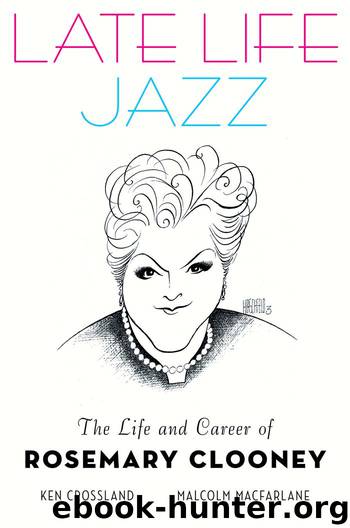
Author:Crossland, Ken & Macfarlane, Malcolm [Crossland, Ken]
Language: eng
Format: epub
Publisher: Oxford University Press, USA
Published: 2013-06-13T00:00:00+00:00
CHAPTER 13
All That Jazz
After varying her Concord theme for the With Love album, Rosemary resumed her songbook series by shifting the focus to two more songwriters. The subjects were Cole Porter and Harold Arlen, both of whom she had known personally. Her songbook series began to draw comparisons with Ella Fitzgerald’s Verve songbooks from the late 1950s, although the two sets were different, both in concept and execution. Ella’s work had been about cataloging the output of the great songsmiths. Recorded mainly as double albums, they had been extensive, offering 30 or more titles from each writer’s portfolio, relying on the then-new microgroove technology to squeeze them onto two vinyl discs. Although known best for her jazz improvisation and scat singing, Ella had sung the songs just as they had been written. The albums were, said critic Gary Giddins, more about establishing the reputations of the songwriters than showcasing Ella’s interpretation of them.1 In contrast, Rosemary’s songbook offerings were personal snapshots. Until CDs replaced vinyl discs in the 1990s, none of the albums exceeded 10 songs, all of them selected because of some meaning or personal significance that they held. Rosemary Clooney Sings the Music of Cole Porter was recorded in January 1982. Porter had been Rosemary’s father’s favorite songwriter. She and Porter had met during the ’50s when their paths had crossed on the movie party circuit. “Very bright, very elegant, a nice man,” was her summation of him in a 1991 interview,2 despite her recollection of having been admonished by him for switching seating plans to suit her preferences at one such party. She was less kind about his songs. “He must not have liked singers,” she told Charles Grodin in 1995 “because he gives you nowhere to breathe.”3 On another occasion, she echoed an oft-quoted Ella Fitzgerald remark that Porter’s penchant for catalog songs was like “singing a laundry list.”4 Reviewing the album, John S. Wilson in the New York Times, was more enthusiastic about the musicians’ performances than Rosemary’s vocals but nevertheless ranked the album highly. “She may be a little shaky in the upper register but it’s the spirit and the phrasing and the sensitivity to her surroundings that make this record an appealing example of unselfconscious jazz singing,” he wrote.5
Not everyone regarded the reborn Rosemary as a jazz singer. It was a debate that would extend through and beyond the remaining 20 years of her life. Downbeat had been one of the first journals to raise the issue in its review of two of her early Concord albums in 1979. The idea of pop singers working with jazz bands was not new, said the magazine, but it was “risky.” Rosemary, it said, had been best known as “a vendor of trifling ditties,” and
the major part of her one time following was not likely to be keyed in on the activities of a small independent jazz label, and especially one with limited advertising. However, jazz purists, despite their common disdain for show biz successes, have
Download
This site does not store any files on its server. We only index and link to content provided by other sites. Please contact the content providers to delete copyright contents if any and email us, we'll remove relevant links or contents immediately.
Cecilia; Or, Memoirs of an Heiress — Volume 2 by Fanny Burney(31959)
Cecilia; Or, Memoirs of an Heiress — Volume 3 by Fanny Burney(31945)
Fanny Burney by Claire Harman(26607)
We're Going to Need More Wine by Gabrielle Union(19053)
Plagued by Fire by Paul Hendrickson(17417)
All the Missing Girls by Megan Miranda(16050)
Cat's cradle by Kurt Vonnegut(15365)
For the Love of Europe by Rick Steves(14174)
Bombshells: Glamour Girls of a Lifetime by Sullivan Steve(14081)
Leonardo da Vinci by Walter Isaacson(13341)
4 3 2 1: A Novel by Paul Auster(12403)
The remains of the day by Kazuo Ishiguro(9004)
Adultolescence by Gabbie Hanna(8930)
Note to Self by Connor Franta(7673)
Diary of a Player by Brad Paisley(7587)
Giovanni's Room by James Baldwin(7352)
What Does This Button Do? by Bruce Dickinson(6210)
Ego Is the Enemy by Ryan Holiday(5455)
Born a Crime by Trevor Noah(5385)
